Punjabi Sanjh Conference
Punjabi is not a mere string of letters; it is the fragrance of centuries of sorrow, of love, of defiance, of loyalty, and of the earth itself. It is that ancient voice which awakens in the verses of Farid, hums softly in the melodies of Shah Hussain, flows through the dohe of Sultan Bahu, dances in the songs of Bulleh Shah, trembles in the sobs of Waris Shah, and has for centuries cast its gentle light upon the threshold of Bibi Pak Daman. Yet today, this language has become a stranger in its own homeland spoken softly within the walls of homes, ignored in schools, and left without a chair in the halls of authority. In such times, the holding of a conference is not a ceremony; it is an attempt to grip the very pulse of a fading tongue, a struggle to preserve the final breaths of a mother language.
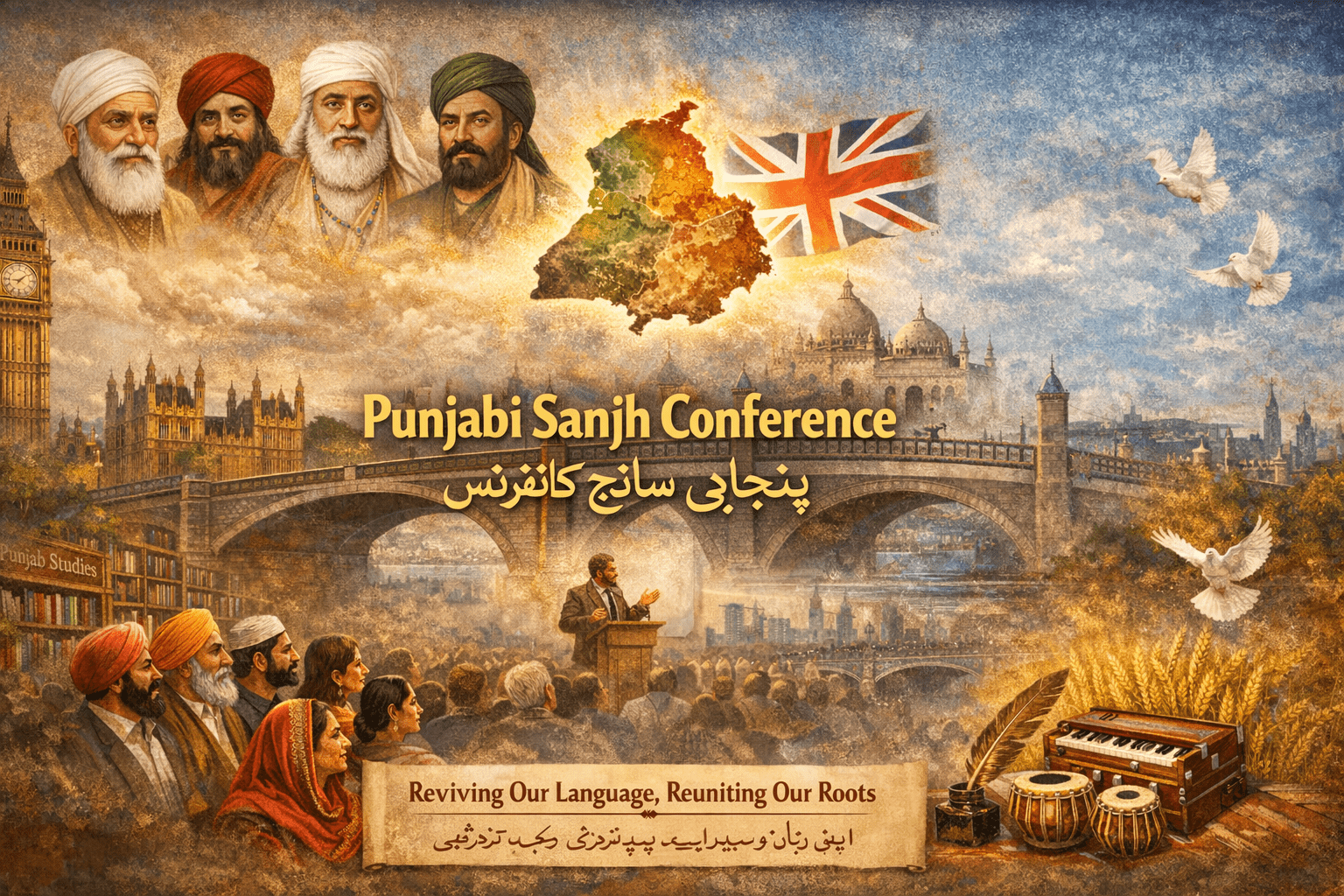
And Britain… Britain is not merely a venue; it is a destiny. It is the land where sons and daughters of Punjab, separated from their soil, raise new homes under unfamiliar skies. Here, generations grow up hearing their heritage only through the fading words of grandparents, and even those voices dim with each passing day. In such a place, a Punjabi Conference becomes a lantern reminding them where their roots lie, from what soil their spirit was shaped, and which forgotten songs still flow within their blood. This is not an event; it is a bridge between two worlds one that cannot be built in Pakistan or India, for there the walls are too tall and the hearts too tired. But in Britain where lands may change yet hearts do not the two banks of Punjab can once again touch. Here, Punjabi Muslims, Sikhs, Hindus, and Christians sit together as heirs of the same earth; here, no borders stifle the path of language, nor does politics fracture the story it carries.
Britain holds within its vastness a quiet confidence upon which civilizations write their future. Its libraries protect centuries, and its literary soil gives new life to every word. If Punjabi is to claim its place on the intellectual map of the world if its script is to witness the coming centuries then its revival must begin in a land where languages are not only spoken but become subjects of research and guardians of collective memory. Above all, a Punjabi Conference in Britain is essential because Punjabi is not a lament of the past; it is a hope for the future. Britain is a place where Punjabi may be celebrated or mourned but never ignored. This gathering is not a meeting; it is a promise to our language, to our identity, and to generations yet unborn.
Manifesto
Punjabi is not merely a language; it is a river of history scented by the bhajans of Dharmodar, flowing through the supplications of Mian Muhammad Bakhsh, and settling gently into the heartbeat of a mother. It is a tongue that has carried centuries of sorrow and centuries of love within its folds. But today, dust begins to gather upon it and its voice grows faint beneath the rising noise of time. Against this quiet erosion, the Punjabi Sanjh Conference stands as a declaration a stirring of consciousness, a pledge to restore the forgotten honour of a mother tongue.
Why is it necessary?
A language is not a dialect alone; it is the final doorway to one’s history. When generations forget their mother tongue, their past dissolves and their future stands unanchored. The Punjabi Sanjh Conference emerges so that the weakening breath of the language may be renewed, our culture, stories, poetry, and identity may be given shape again, and the young may learn which echoes of the soil still resound within their veins. This is not an event; it is a moment of civilizational survival.
Why Britain?
Because Britain is that bridge between two worlds where the past and future of Punjabi may hold hands. Here live those generations whose ears heard their last Punjabi words from grandmothers and grandfathers; for them, this gathering becomes the only path back to their roots. Here, neither the politics of East Punjab nor the pressures of West Punjab intervene only people remain, and the language that binds them. This is the land where the two Punjabs may sit together, laugh together, and speak together. Britain is also the centre of global scholarship where languages do not fade but become research, curricula, and institutions. If Punjabi wishes to rise again on the global intellectual map, its journey must begin here. And above all, Britain grants languages a dignity often denied to them in their own homelands. Punjabi is not “regional” here, nor “politicized” it is a radiant cultural torch.
Our Dream
We dream of a future where Punjabi stands proud on global academic and literary platforms; where its words enter research, theatre, cinema, music, and curriculum; and where the world recognises that Punjabi is not merely a language but a temperament, a spirit, and the ancestral wealth of an entire people.
Our Pledge
We shall restore to our language the honour its letters have safeguarded for centuries. We shall build a platform for future generations where Punjabi is not only remembered but lived spoken, sung, studied, and celebrated. This conference is not an ending; it is the dawn of Punjabi’s reborn morning.